
🚀 Website Age Checker
Discover when any website first went live using advanced detection methods
💡 Our free website age checker uses historical snapshots to determine the true launch date and site age
What is Website Age Checker?
A Website Age Checker is an online tool used to determine the exact launch date and historical age of a site. Unlike domain age, which tracks registration, a website age checker identifies when a site first hosted content using signals from the Internet Archive and the site’s history.
How to Check Website Age?
Follow these steps to check any website’s age:
- Enter the URL: Paste the domain name (e.g., https://example.com) into the input field above.
- Run the Analysis: Click the “Analyze” button or press Enter to initiate the scan.
- Review Data: The tool will display the estimated website launch date and website age.
Website Age vs. Domain Age: What’s the Difference?
Understanding the distinction between domain age and website age is crucial for accurate SEO analysis. They are often confused, but they represent two completely different metrics:
- Domain Age (Registration Date): This is simply the date the domain name was purchased from a registrar. It does not mean a website existed at that time. A domain can sit “parked” or inactive for years before any content is published.
- Website Age (Launch Date): This refers to when the site actually started hosting content and became publicly accessible. This is the metric that matters most for trust assessment and user credibility.
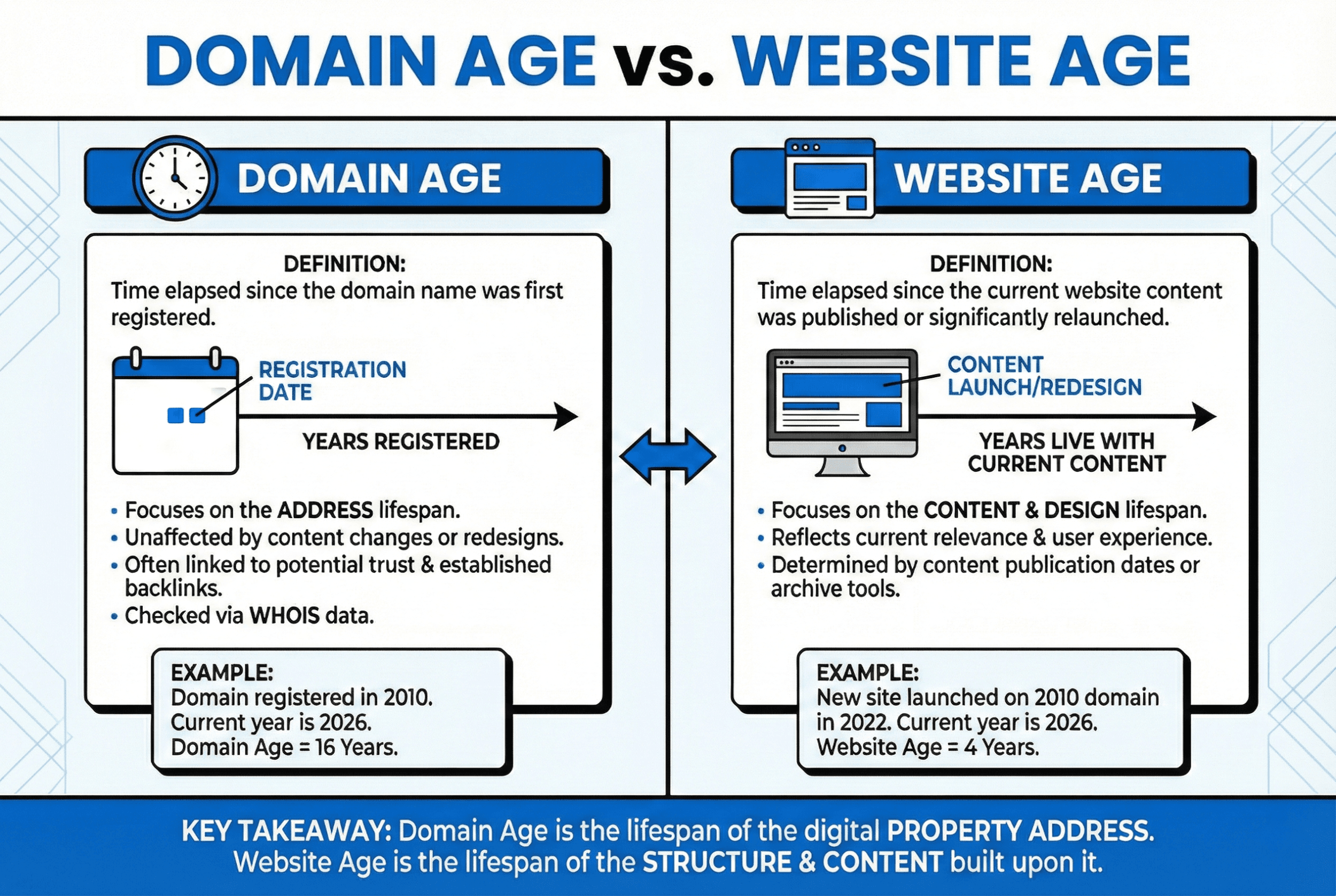
For example, a domain might be 16 years old (registered in 2010), but the current business website might have only launched in 2022.
Why Use a Site Age Checker for SEO and Business
Search engines like Google use hundreds of factors to rank pages, and while they have stated that domain age is not a direct ranking factor, the history of a website plays a massive indirect role.
1. Authority and Trustworthiness
Older websites typically have more time to accumulate backlinks, content depth, and user signals. A website age checker helps verify if a site has the longevity to be considered a trusted authority in its niche.
2. Competitor Benchmarking
Knowing when a competitor entered the market provides valuable business intelligence. If a rival ranks highly despite being new, they may be using aggressive marketing strategies worth analyzing.
3. Scam Detection & Vetting
Fraudulent sites are often created days or weeks before a scam campaign launches. By checking the website creation date, consumers can spot “overnight” stores claiming to have years of experience.
How This Tool Analyzes Website History
To provide the most accurate results, this tool goes beyond simple WHOIS lookups. It employs a multi-step verification process:
- Snapshot Integration: Checks the Internet Archive to find the first archived snapshot, proving when the site was visually active.
- Content Pattern Recognition: Scans website history and legal notices to identify self-reported establishment dates.
Does Website Age Affect Google Rankings?
This is a common question among SEO professionals. According to Google’s search advocates, the age of a domain alone doesn’t magically boost rankings. However, an older website often benefits from:
- Established Backlink Profiles: Years of earning links naturally.
- Content Library: A larger footprint of indexed keywords.
- Historical Data: A track record of not violating spam policies.
- Trustworthiness: It builds the trust over time in the eyes of Visitors and Search Engines.
Therefore, while a new domain can rank well with excellent content, an aged website often has a “head start” in the SEO sandbox.
Frequently Asked Questions (FAQs)
Q: Is this Website Age Checker free to use?
A: Yes, this tool is completely free for checking the age and history of any public website.
Q: Can a website be older than its domain age?
A: No. A website cannot exist before its domain is registered. However, a business can be older than its website if it operated offline before going digital.
Q: How accurate is the launch date estimation?
A: The tool uses high-confidence data sources. The exact launch day is an algorithmic estimate based on the first detected activity.